Construction site toilets on a Texas job follow one federal rule, OSHA 29 CFR 1926.51. A crew of 20 or fewer needs at least one toilet. Bigger crews need a toilet seat and a urinal for every 40 workers, or for every 50 once the crew reaches 200. Texas doesn’t run its own OSHA plan, so that federal table is the number your Houston job site is held to.
We’re Action Roll-Offs. We rent roll-off dumpsters and porta potties to contractors across the Houston area. Below is the exact OSHA table, worked examples by crew size, the servicing and handwashing rules, and how it all applies to construction site workers in Texas. It matters because OSHA ties these sanitation regulations to worker health, and a missing or dirty bathroom is a compliance problem as well as a comfort issue.
How many construction site toilets OSHA requires
The minimum number of sanitation facilities depends on how many employees you have on site. The count comes from Table D-1 in 29 CFR 1926.51, paragraph (c). This is the table exactly as OSHA prints it.
| Number of employees | Minimum number of facilities |
|---|---|
| 20 or less | 1. |
| 20 or more | 1 toilet seat and 1 urinal per 40 workers. |
| 200 or more | 1 toilet seat and 1 urinal per 50 workers. |
The same paragraph adds a floor for short work. Under temporary field conditions, OSHA says provisions must be made so that not less than one toilet facility is available. Even a short, temporary setup still needs a toilet.
Worked examples by crew size
Here’s how the table plays out on construction sites of different sizes.
- 12 construction workers. 20 or less, so 1 toilet.
- 40 workers. 1 toilet seat and 1 urinal.
- 80 workers. 2 toilet seats and 2 urinals.
- 250 workers. The 200 or more row applies, so 5 toilet seats and 5 urinals.
The table does not spell out how to count a crew that falls between steps, like 60 workers. Rounding up keeps you covered. Count the peak crew, too, not the average, because the minimum number has to hold on your busiest day. The specific requirements vary depending on headcount, so recheck the table whenever the duration or size of the job changes.
Why Texas job sites follow the federal rule
Some states write their own workplace safety rules. Texas does not. OSHA’s own list of state plans says Texas is not an OSHA-approved State Plan and is under federal OSHA jurisdiction, which covers most private sector workers in the state.
So a private construction project in Houston, Katy or anywhere else in Texas answers to 29 CFR 1926.51. One exception is worth knowing. State and local government workers are not covered by federal OSHA.
A dirty porta potty does not count
Hitting the number is not enough. In a 2006 interpretation letter, OSHA was asked whether toilets in an unsanitary condition count toward the minimum. The answer was no. A toilet isn’t “provided” under the rule if it’s unsanitary, because an unusable toilet isn’t available.
The same letter says toilets that take too long to get to don’t count either. So two units parked at the far gate of a spread-out site may not be doing the job your count says they are.
OSHA’s restroom page explains why. Its sanitation standards are meant to ensure that workers don’t suffer adverse health effects when toilets aren’t sanitary or aren’t available when needed.
OSHA also put a ceiling on the worry. The standard does not require toilet facilities to be in immaculate condition to be considered sanitary. Clean, hygienic and usable is the bar.
How often portable toilets need servicing
OSHA does not set a servicing schedule in the standard itself. In the 2006 letter, it points to the ANSI Z4.3 servicing schedule as one way for an employer to keep toilets sanitary.
- ANSI calls for a toilet used by up to 10 people to be serviced at least once a week.
- One toilet that serves 20 workers and is serviced twice a week would likely be sanitary, per OSHA.
- “Servicing” in the ANSI standard means emptying the waste and cleaning the toilet facility.
The pattern is simple. More workers per unit means more frequent service and regular cleaning. If your crew grows mid-project, the service schedule should grow with it, or you add units.
Placement and easy access on the job site
OSHA requires employers to provide all workers with sanitary and immediately available toilet facilities. Its restroom guidance says employers must let workers leave their work locations to use a restroom when needed, provide enough restrooms for the size of the workforce to prevent long lines, and avoid unreasonable restrictions on restroom use.
On a real site, that comes down to a few practical calls.
- Make portable toilets easily accessible. Put units where crews can reach them quickly, not just where they’re out of the way.
- Spread them out on a large or multi-level site so nobody makes a long walk.
- Keep them located on safe, level ground away from hazards like equipment paths.
- Leave a clear path for the service truck, since a unit the truck can’t reach is a unit that won’t get cleaned.
Handwashing facilities and drinking water
Toilets are only part of 1926.51. The same standard covers washing up and water.
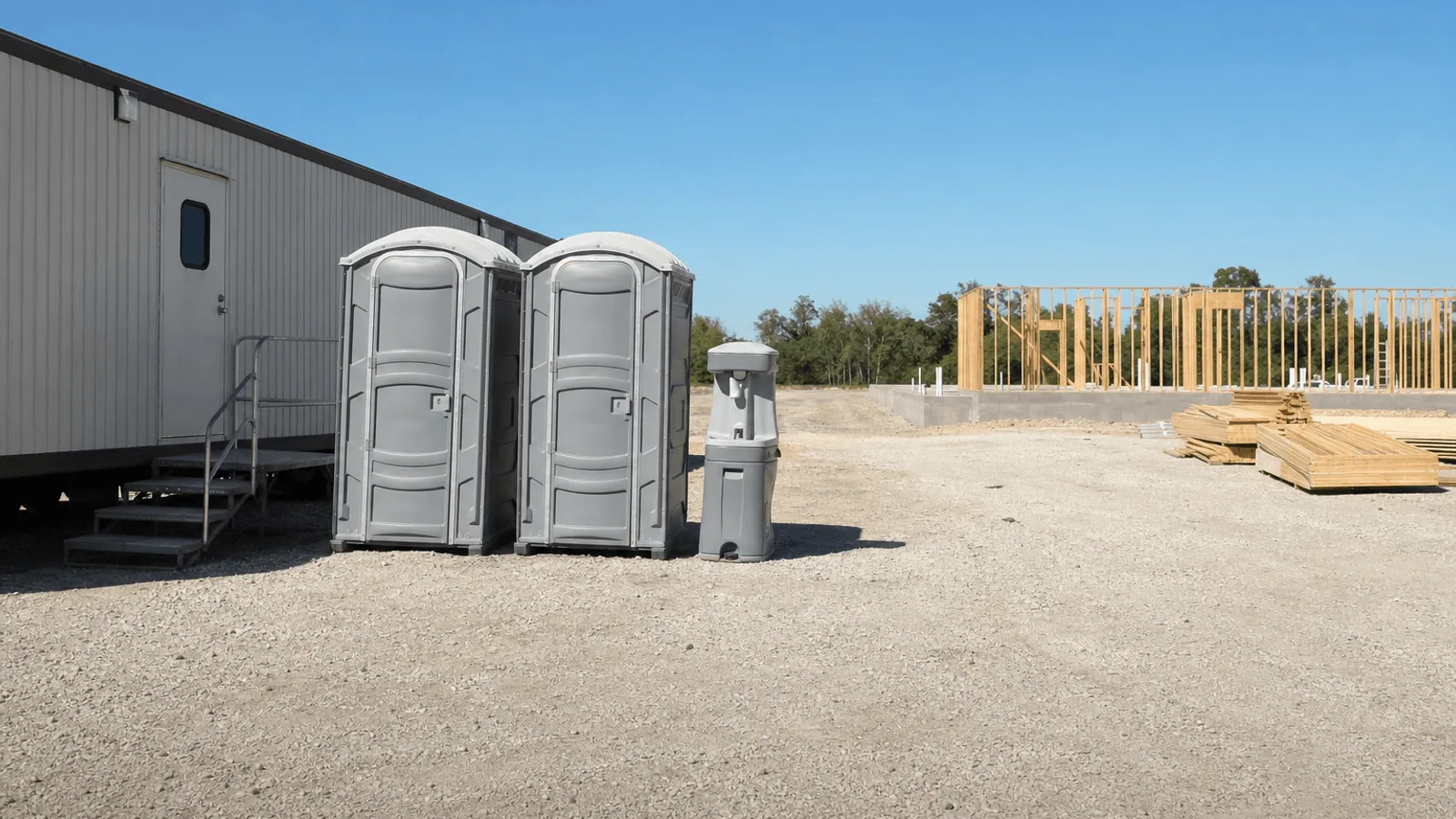
- Lavatories. They must be made available in all places of employment, a job site included. Each lavatory needs hot and cold running water or tepid running water, hand soap or a similar cleansing agent, and individual hand towels or air blowers convenient to the lavatories. On a site without plumbing, plan where hand washing stations will sit before the first crew arrives.
- Harmful contaminants. Crews applying paints, coatings, herbicides or insecticides need adequate washing facilities in near proximity to the worksite. OSHA has said a can of waterless hand cleaner and rags typically is not enough there.
- Drinking water. An adequate supply of potable water is required on every jobsite.
- No food in the toilet room. Workers may not eat or drink in a toilet room.
Which toilet types OSHA allows
A job site without a sanitary sewer can’t just hook up a flush toilet. For those sites, 1926.51(c)(3) allows four kinds of toilet facilities, unless local codes prohibit them.
- Privies, where their use will not contaminate ground or surface water
- Chemical toilets
- Recirculating toilets
- Combustion toilets
The chemical toilet is what everyone on site calls a porta potty or portable toilet. It’s the standard answer for a construction project without sewer service.
Mobile crews and short jobs
The toilet rules do not apply to mobile crews that have transportation readily available to nearby toilet facilities. OSHA explained what “nearby” means in a 2002 letter on mobile crews. In general, toilets count as nearby if it takes less than 10 minutes to get to them.
That exception is narrow. A crew that moves from site to site through the day can lean on it. A crew that reports to one conventional construction project for days, weeks or longer is not a mobile crew, and that site needs its own toilets.
Renting porta potties for a Houston job site
Action rents porta potties for construction and job sites in Houston and the Harris County area. Our cost-effective commercial rentals include regular delivery, maintenance and repair, and you can set it up as a one-time rental or ongoing service. The team is available 24 hours a day to deliver units and keep maintaining them for the duration of the job.
See our page on porta potty rental in Houston for the service details. When you know your peak crew size, send it with a porta potty quote request so the unit count in your quote lines up with the OSHA table.
Pair it with a roll-off for job site debris
If your site needs toilets, it needs somewhere to put the debris too. We rent 20, 30 and 40 yard roll-offs for construction dumpster rental in Houston, and we quote a flat rate before delivery.
Roofing shingles, concrete, brick, dirt and tires don’t go in an Action dumpster. Our guide to construction debris disposal covers what goes where.
Frequently asked questions
How many toilets do you need on a construction site?
OSHA requires 1 toilet for 20 or fewer workers. For 20 or more, it’s 1 toilet seat and 1 urinal per 40 workers. For 200 or more, it’s 1 toilet seat and 1 urinal per 50 workers.
What are construction site toilets called?
Most crews call them porta potties or portable toilets. OSHA’s rule calls them chemical toilets, and it also allows privies, recirculating toilets and combustion toilets on sites without a sanitary sewer.
Does a Texas job site follow OSHA’s toilet rule?
Yes. Texas has no OSHA-approved State Plan, so federal OSHA covers most private sector workers in Texas, and 29 CFR 1926.51 sets the toilet count on their job sites.
How often should a construction porta potty be serviced?
OSHA points to the ANSI Z4.3 schedule, which calls for a toilet used by up to 10 people to be serviced at least once a week. A toilet shared by more workers needs service more often.
Get toilets and a dumpster on your site
Contact us with your crew size and site address, and we’ll discuss a setup with portable toilets and a roll-off for your job. Call us at (979) 826-2815, or request a dumpster quote online.